
Table of Contents
- What Drives the Cost of Professional Team Headshots
- Group Headshot Session Duration and What It Includes
- On-Site Team Headshot Sessions
- AI Headshots vs Professional Photography for Teams
- Retouching Tiers, Usage Rights, and Licensing Fees
- How to Prepare for Team Headshots
- Conclusion
- Frequently Asked Questions
Last Updated: October 2, 2026
What Drives the Cost of Professional Team Headshots
The cost of professional team headshots depends on four variables: session type, team size, retouching depth, and image usage.
This guide from MarkChamberlin explains the considerations in planning staff photos and how to budget without overpaying. We have photographed corporate teams for over 25 years.
Factors Affecting Photography Rates
On location whole staff sessions vs individual studio or on location photoshoot
- The time alotted and complexity of the look desired. This includes backgrounds, single or multi-light setups
- Team size – We can handle a small team of 3-10 people to over 100 staff.
- Retouching depth – Basic skin tone and cropping is included. Digital enhancement of fine lines, bags, discoloration, scars and other distractions can be arranged.
- Deliverable format – Web-optimized files and high res printable images will be included
- Turnaround time – Normal delivery is 48 hours. Rush delivery has an added charge.
- Usage rights – All images can be used on social and web based media. If they are to used in a publication such as a magazine or printed marketing collateral, there may be an additional fee.
Individual vs. Group Session Pricing
Groups sessions are priced per group session. Rates are usually an hourly or half/full day rate. They eliminate staff travel compensation. A very consistent look can be guaranteed.
Individual studio sitting. A sitting can be 30-60 minute. The subject can pick a scheduled time, change wardrobe and background and use more creative posing. There will be an array of proofs to choose from.

Group Headshot Session Duration and What It Includes
A standard group headshot session runs 10 to 15 minutes per person, including setup, posing, and frame reviews. A 20-person team should plan a full day or two half-days.
Rushing is the most common mistake. Compressed sessions make people feel hurried, their expressions stiffen, and the retouching bill rises.
What’s Included in a Standard Package
Most packages include the session, basic post-processing, and a set number of final images per person. What varies is how much retouching is bundled and which file formats you receive.
A typical package covers:
- Pre-shoot planning and a shot list
- Lighting equipment and backdrop setup
- Direction and posing guidance during the session
- Basic retouching on selected images
- High-resolution files plus web-optimized versions
- A defined window for additional edits
On-Site Team Headshot Sessions
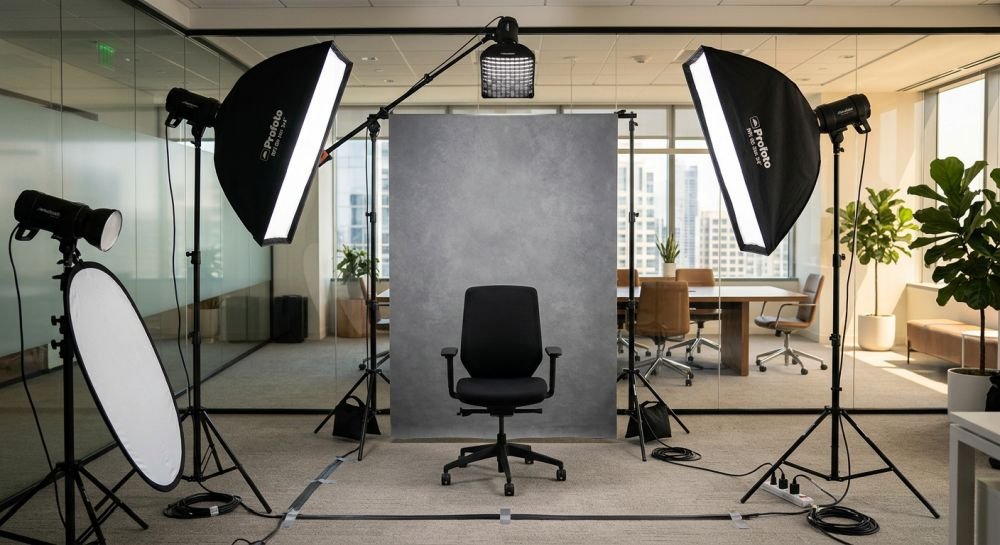
On-site sessions bring the studio to your office; studio sessions bring your team to a controlled space. Neither is automatically cheaper, the right choice depends on team size, disruption, and how much control the room gives the photographer.
On-site wins for a large team, a tight deadline, or a distributed group flying in for one day: the photographer’s time costs more, but you save on travel and lost work hours.
Why On-Site Setups Cost More
On-site work is a logistics project, not the same job in a different room. The cost drivers:
- Gear transport and setup time, strobes, light stands, sandbags, a backdrop system, and a tethered capture station must be packed, moved, unpacked, and tested. Setup and teardown can add an hour or more on each end of the day.
- Ambient-light control, a studio has controllable light; an office has windows, overhead fluorescents, and glass walls. Neutralizing bad room light takes time and sometimes extra gear.
- Space constraints, a conference room with ceiling-height clearance and a door that closes works well. A glass-walled space with harsh afternoon sun does not, and may require an advance scout.
- Minimum billable hours, many photographers apply a minimum for on-site work because the day is committed regardless of headcount.
- Travel radius, a photographer based an hour away may add a travel fee, and distant or multi-day on-site work is often quoted as a day rate plus travel.
In a well-run quote these are line items, not surprises.
The Real Trade-Off: Photographer Cost vs. Team Downtime
The comparison that matters is total project cost, including the value of your team’s time.
For a 25-person team, a studio session means 25 people lose time to travel and waiting.
Under five people, the math flips: the on-site premium is hard to justify when a handful can book individual studio time, which also gives each person more control over wardrobe, background, and timing.
Equipment and Lighting Requirements for On-Site Setups
On-site work demands portable lighting, a backdrop system, and enough space for a consistent setup. A conference room with ceiling-height clearance and controlled ambient light works; a glass-walled space with harsh afternoon sun does not.
This is where experience shows. A photographer who has done on-site corporate work knows how to neutralize bad room light and keep skin tones consistent across dozens of people shot over hours.
Coordinating Remote and Distributed Teams
For remote or distributed teams, flying people in for a single studio day adds travel cost, so many companies book on-site sessions around an existing event or offsite, the headshot session rides along with already-budgeted travel.
A few patterns that work:
- Anchor the shoot to an existing gathering, an annual sales meeting, a leadership offsite, or a company all-hands. The travel is already paid for.
- Book a multi-city on-site tour, a photographer may quote a route covering several offices in one trip, spreading travel cost across more people than a single-city booking.
- Use a consistent setup across locations, same backdrop, lighting kit, and retouching tier, so the final set looks unified across different rooms and days.
- Standardize the shot list, one crop, one background, one expression direction, so remote employees photographed in a satellite office match the headquarters team.
AI Headshots vs Professional Photography for Teams
AI-generated headshots are cheaper upfront and faster to deliver, but they carry real risks for corporate branding: inconsistent likeness, uncanny details, and unclear licensing.
For a solo profile picture, AI can be fine. For a team page that represents your company publicly, a business portrait needs to look like the actual person.
Where AI falls short:
- Likeness accuracy – generated faces drift from the real person
- Consistency – lighting and tone vary across a set
- Usage rights – unclear commercial usage terms
- Trust – clients and candidates notice when something looks off
Professional photography costs more because it produces a reliable, rights-cleared set of digital assets for your website, LinkedIn, and print materials.
Retouching Tiers, Usage Rights, and Licensing Fees
Retouching is not one service, it runs on a tiered scale, and the tier you choose changes both price and final look.
|
Tier |
What It Covers |
Typical Use Case |
Relative Cost Per Image |
|---|---|---|---|
|
Basic |
Color, exposure, minor blemish removal |
Internal directories, small teams |
Included in most session fees |
|
Standard |
Skin smoothing, background cleanup, stray hair |
Website team pages, LinkedIn |
Modest per-image add-on |
|
Advanced |
Full skin work, background replacement, composite-ready |
Executive portraits, press materials |
Multiplies the basic rate several times over |
|
Custom |
Branded background, color grading to brand palette |
Campaigns, annual reports |
Quoted per project, not per image |
The math matters most at scale. A 30-person team where every image needs advanced retouching is a post-production problem, and post-production is where the invoice grows fastest. The retouching line commonly equals or exceeds the session fee once a team passes roughly 20 people.
What Actually Changes Between Tiers
The gap between basic and advanced is a different workflow, not a slider.
- Basic is batch work: white balance, exposure, crop, dust spots, dozens of frames an hour.
- Standard adds localized work: texture-preserving skin smoothing, stray-hair cleanup, background spot removal.
- Advanced is manual: frequency separation, background replacement or extension, composite-ready layering. Time per image can run into the tens of minutes.
- Custom is a design project: branded backdrops, brand-palette color grading, and often a review cycle with the client’s marketing team.
Ask which tier is bundled and the per-image rate for each step up. That question prevents the most common billing dispute in corporate headshot work.
Usage Rights and Licensing Fees
Usage rights and image licensing are the second hidden cost, and the one most corporate buyers overlook. A session fee usually covers a defined scope, commonly internal use or a company website.
Licensing is usually structured along three axes:
- Channel, internal only, web, print, paid media, or all of the above
- Duration, a one-year term versus perpetual use
- Territory, domestic use versus worldwide
A photographer retaining copyright and granting a limited license is standard in commercial photography. You are buying the right to use the images within a defined scope, not the copyright.
A Practical Way to Budget Retouching and Licensing
Start with the deliverable, not the session. Ask where these images will appear in the next 12 months. If it is only the company website and an internal directory, basic or standard retouching plus a web-use license is usually enough.
Budget retouching and licensing as a separate line from the session fee. Teams that separate those lines negotiate better and avoid discovering mid-project that their images cannot legally be used where marketing wants them.
How to Prepare for Team Headshots
Preparation cuts session time, which cuts cost. Teams that arrive ready finish faster and need less retouching.
A simple preparation checklist:
- Confirm the shot list and background options with your photographer
- Send wardrobe guidance to everyone two weeks ahead
- Book a room with good space and controllable light for on-site shoots
- Schedule people in 15-minute blocks with buffer time
- Collect any specific image needs, such as website crops or press use
- Confirm turnaround time and delivery format in writing
- Assign one person to manage the schedule on shoot day
Conclusion
Budgeting for team headshots gets messy when quotes arrive as single numbers with no breakdown. The teams that get the best results ask about retouching tiers, usage rights, travel fees, and turnaround before comparing price.
MarkChamberlin has spent 16 years photographing corporate teams, executive portraits, and commercial work across Mid-Michigan. Our studio handles the full process, from pre-shoot planning and lighting setup to post-processing and final delivery, so you get images that are ready to use and look like your actual team. If you want a quote built around your headcount and usage needs rather than a flat guess, contact us and we will walk you through the options.
Frequently Asked Questions
What factors influence the cost of professional team headshots?
Pricing depends on group size, session duration, location (on-site vs. studio), retouching level, and usage rights. Larger teams often get per-person pricing breaks, while on-site shoots add travel and setup fees. Post-production tiers, from basic color correction to advanced retouching, also affect the final invoice. Licensing for commercial use may carry separate fees.
Is there a cost difference between individual and group headshot sessions?
Yes. Individual sessions typically cost more per person because they require dedicated studio time. Group sessions spread the photographer’s day rate across multiple people, lowering the per-person cost. A team of 10 might pay significantly less per headshot than a single executive booking a solo session, especially when the shoot is scheduled efficiently.
Are AI-generated headshots a cost-effective alternative to professional photography?
AI headshots can be cheaper upfront, but they often lack the nuance, expression, and brand consistency of a professional session. For teams that need uniform backgrounds and reliable high-resolution files for websites, annual reports, and press releases, professional photography usually delivers more usable assets and fewer retakes. AI works best for quick, informal needs, not corporate branding.
How many images should a team expect from a professional headshot session?
A typical team session yields 3-5 edited images per person, including a few pose variations and background options. The exact number depends on session duration and the package selected. Some photographers provide a proofing gallery where team members choose their favorites before final retouching, ensuring everyone gets a headshot they are happy with.
The hardest part of a corporate headshot project is not the shoot. It is knowing what to ask before you book so the final invoice matches the quote. MarkChamberlin builds every team session around a clear shot list, defined retouching tiers, and delivery formats you can actually use across your website and marketing. Get started with MarkChamberlin and walk away with a consistent set of professional team headshots your whole company can rely on.